

Developing more sustainable food packaging is not only about finding alternative materials. New solutions must also be able to protect food, work with packaging equipment and maintain their performance throughout storage. This is particularly challenging for fresh meat, where packaging plays an essential role in preserving product quality and helping to prevent food waste.
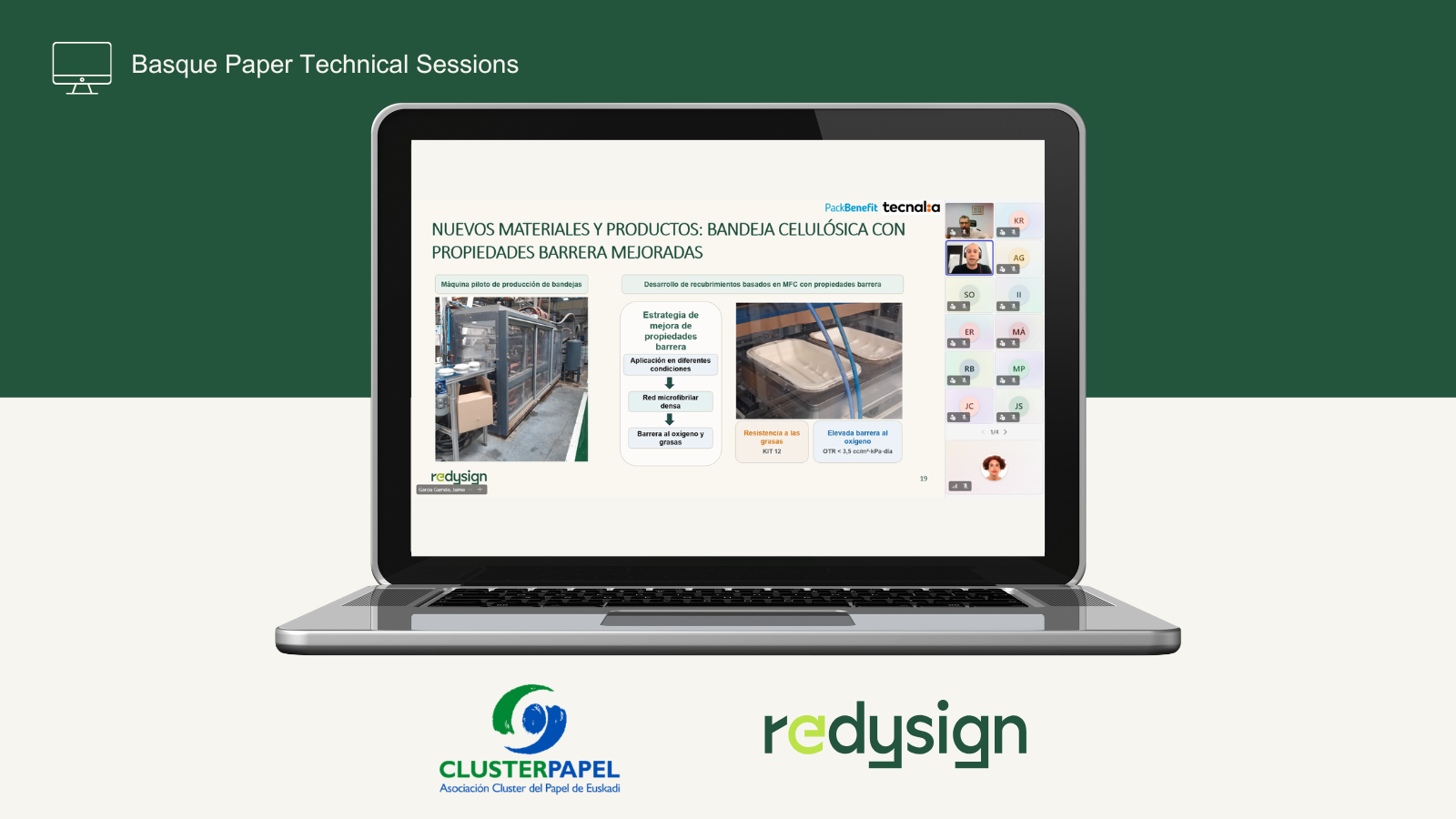
Within REDYSIGN, different recyclable-by-design fibre-based packaging solutions mainly derived from wood-based materials are being developed as alternatives to conventional plastic packaging. After extensive development and laboratory work on individual components, the project has now taken an important step forward by testing complete packaging systems under conditions closer to real food-packaging applications.
From packaging prototypes to fresh chicken trials
The first packaging trials within REDYSIGN were carried out in May 2026 in Spain, under refrigerated and hygienic conditions designed to reproduce a realistic fresh poultry packaging scenario. The validation campaign involved EROSKI, TECNALIA, PACKBENEFIT and ZABALA, combining expertise in retail, packaging development, technical validation and project coordination.
The validation campaign focused on fresh chicken breast, a highly perishable product that provides a demanding test for packaging performance.
Different REDYSIGN solutions were evaluated, including wet-thermoformed and dry-thermoformed fibre-based trays, together with lidding films based on microfibrillated cellulose (MFC). The trials also included two types of REDYSIGN absorbent pads and smart sensors designed to provide a visible indication of food deterioration. For comparison, chicken was also packed using a conventional commercial PET tray system currently representative of fresh poultry packaging.
More than 100 packages were prepared using modified atmosphere packaging and subsequently stored under refrigerated conditions. During storage, not only the condition of the different packaging elements was monitored but also the quality of the chicken through microbiological, physicochemical and sensory analyses. Gas composition, moisture management and the behaviour of the smart sensors were also evaluated.
What did the trials show?
The tests provided valuable information about both the potential of the REDYSIGN developments and the areas that still require improvement.
Overall, the campaign confirmed that the REDYSIGN fibre-based packaging systems can be successfully tested as complete packaging solutions, while also showing that further optimisation is needed to move closer to the preservation performance of current commercial references. In particular, barrier performance was highlighted as a key area for improvement, especially to better maintain the intended modified atmosphere and support product preservation over time.
Encouragingly, the REDYSIGN bio-based absorbent pads showed performance broadly comparable to the commercial reference pads under the conditions tested, successfully retaining the liquid released by the chicken. This represents a positive result for the continued development of the complete packaging system.
The food deterioration sensors also showed promising preliminary behaviour. Their colour response became more evident as product deterioration progressed, supporting their potential as an additional visual tool for monitoring food quality.
Learning from real conditions
Testing prototypes under realistic conditions is an essential part of developing new packaging solutions. These trials have shown that replacing conventional plastic packaging requires all components — trays, films, barriers, absorbent pads and smart elements — to work together as a complete system.
The results now provide REDYSIGN researchers with clear priorities for the next development stages, particularly improving barrier properties, resistance to moisture, tray integrity and film compatibility.
Article prepared in collaboration with Álvaro Tejado (project coordinator) and Jaime García from TECNALIA, Rebeca Valladares from PackBenefit, Ainara Llona y Amaia Uriarte from EROSKI and Gary Chinga Carrasco from RISE PFI.