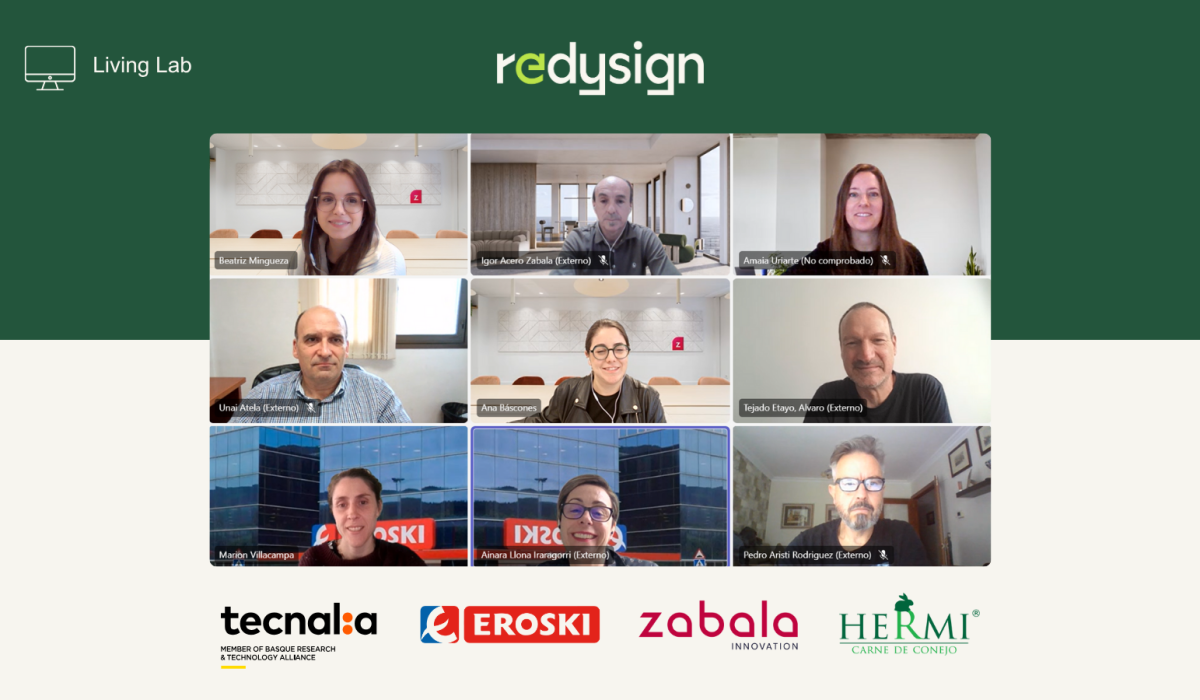
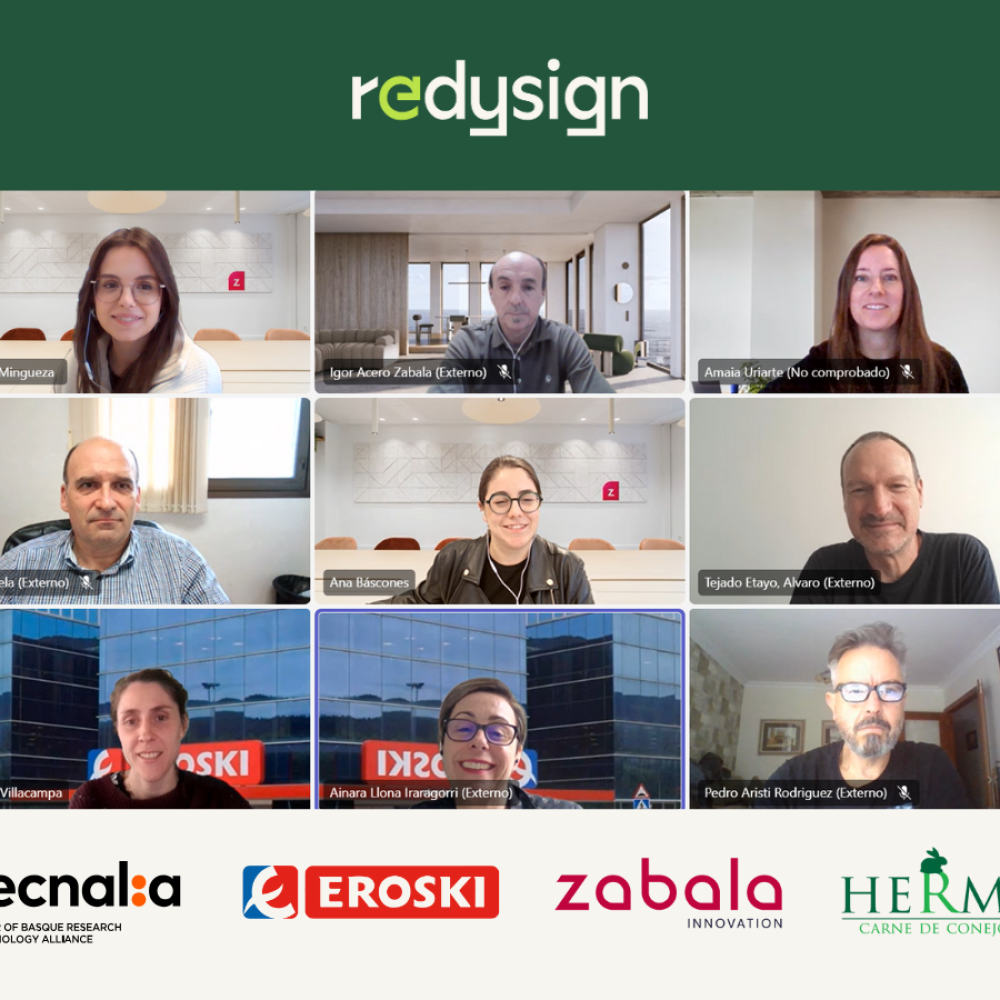
This collaborative session brought together Eroski, TECNALIA, Grupo Hermi and Zabala Innovation to share conclusions on recent smart, recyclable-by-design packaging solutions.
On 5 November, Eroski organised the first Living Lab within the framework of the REDYSIGN project, focused on exploring how VTT’s smart sensors can support the development of smarter, recyclable-by-design fibre-based packaging solutions for the fresh meat sector.
The session was designed to connect technological innovation with real market insights, engaging representatives from retail, research, and the meat supply chain in a collaborative discussion on the practical applications and potential of REDYSIGN’s sensor technologies. Thus, the meeting brought together our project coordinator, Álvaro Tejado (TECNALIA); Unai Atela, Manager at Grupo Hermi; Igor Acero, representing Eroski’s Fresh Meat Commercial and Purchasing Section; Pedro Aristi, from the Private Label Fresh Meat Technical Department at Eroski; Marion Villacampa, Amaia Uriarte, and Ainara Llona, from Eroski’s R+D+i Innovation Area; as well as Ana Báscones and Beatriz Mingueza, from Zabala Innovation.
Smart sensors for safer, more sustainable packaging
The Living Lab focused on the validation of two smart sensors developed by VTT within REDYSIGN’s research on digital tools and traceability. The first sensor monitors temperature variations along the cold chain, while the second detects volatile compounds that signal the onset of meat spoilage.
The results presented during the session showed that the sensors can provide valuable information about product freshness and storage conditions, which can play a key role in extending shelf life, ensuring food safety, and supporting more efficient resource use. Such advances are particularly relevant to REDYSIGN’s mission of developing sustainable and recyclable-by-design packaging that meets both environmental and consumer needs.
Towards integration and large-scale implementation
A key part of the discussion revolved around how to integrate the sensors into industrial packaging processes. While current prototypes have been tested in pilot conditions, future steps will aim to embed the technology directly into packaging materials, particularly the film or lid components, simplifying application and improving production efficiency.
The Living Lab also explored possibilities for further development of the sensor design and communication features, aiming to provide clearer and more intuitive indications of product freshness for retailers and consumers.
Market perspectives and next steps
From a commercial standpoint, the Living Lab underscored the potential of smart packaging to help retailers and suppliers optimise stock management and reduce food waste. Participants also highlighted the importance of studying consumer perception, ensuring that these technologies are introduced in a way that builds trust and demonstrates added value.
The meeting concluded with broad agreement on the technical potential and sustainability benefits of these innovations, while identifying key challenges related to industrial integration, validation under real conditions, and consumer acceptance.
These findings will inform the next stages of REDYSIGN’s development and support its goal of creating smart, fibre-based packaging that advances the transition towards a circular and resource-efficient packaging industry.