

In 2022, each EU citizen generated 187 kg of packaging waste, with a significant portion originating from food packaging. One of the main challenges is to develop cost-effective, eco-friendly and sustainable packaging to secure food quality and extend the lifetime of packaged food products, such as meat and chicken. For this purpose, low-cost smart sensors are needed to monitor food quality and safety within the packaging, providing real-time information about freshness, spoilage, and potential contamination. These sensors can detect various factors like gas levels (oxygen, carbon dioxide), temperature, humidity, and the presence of specific chemicals or microorganisms. Furthermore, smart bio-based sensors are pivotal in achieving resource efficiency and zero waste goals outlined in the European Green Deal. These sensors can be integrated into bio-based packaging materials, such as microfibrillated cellulose (MFC) films developed in the REDYSIGN project, thereby ensuring they are recyclable and eco-friendly.
VTT has a strong background in the development of micro- and nanofibrillated cellulose films and has built a unique pilot, SUTCO, to produce films and coatings from bio-based materials. In REDYSIGN, VTT will manufacture lidding films for the fresh meat packaging from lignin containing MFCs refined by Valmet’s conical refining technology. MFC films are known to have excellent barrier against oxygen and grease and with the aid of lignin and additional barrier coatings their water vapour barrier and hydrophobicity will be increased to meet the standards of fresh meat packaging. VTT has also a unique Roll to Roll printing facilities were printed electrical circuit and optical sensors can be produced directly on the flexible films. The sensors will make the fibre-based fresh meat packaging smart as they will be integrated into the lidding films. This can be done either by directly printing the sensors on the MFC films using functional inks or by integrating the sensors to the package during the packing of the product.
Visual spoilage indicator and cold chain sensor
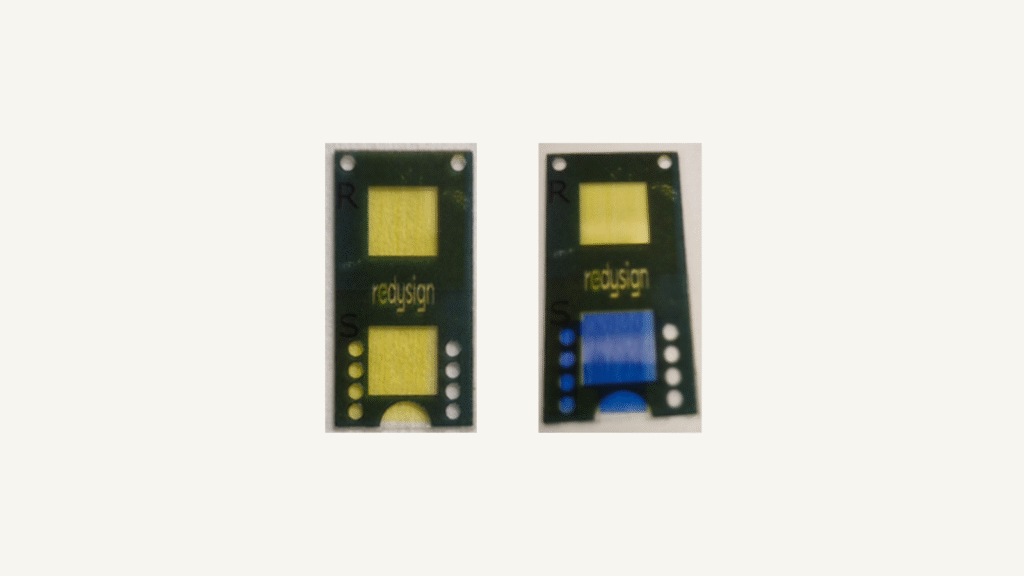
A printable sensor, which changes colour when it detects spoilage-indicating metabolites is a low-cost solution for example when monitoring is needed in customer packages. The roll-to-roll manufacturable indicator is safe also for food contact and thereby possible to add inside the package (e.g. in the transparent lidding film). In REDYSIGN, VTT has used an inkjettable bromophenol blue (BPB) solution as the indicator. BPB is based on a chromogenic reaction and thereby the sensor changes its colour when spoilage metabolites are detected, e.g. when the chicken starts to go bad. This colour change can be observed by eye or by camera.

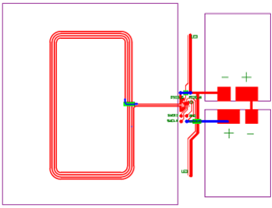
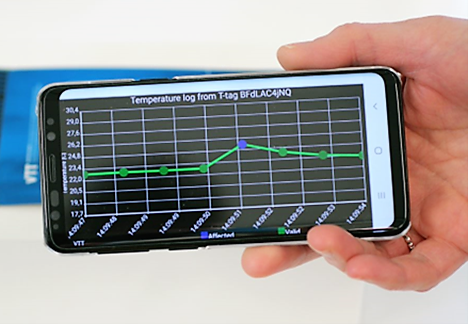
Cold chain monitoring of meat packages during transportation is essential to secure food quality. Shop keepers can also prove an unbroken cold chain when temperature data is stored and collected from the food producers to the customers. Cold sensors with memory option are suitable for transport cases but possibly too expensive for individual customer food packages. VTT has also developed a mobile phone application which can be used to read temperature log during transportation, but also to set a limit temperature, which switches the led on when the set temperature is exceeded.
Article prepared in collaboration with the VTT Team: Tapio Mäkelä, Tetyana Koso, Hannes Orelma and Ilona Leppänen.