REDYSIGN continues to strengthen its scientific foundations with the publication of a new peer-reviewed article in the journal Cleaner Engineering and Technology.
A new scientific publication developed within the REDYSIGN project investigates innovative enzymatic approaches to enhance moisture resistance in fibre-based materials, an important step towards advancing recyclable-by-design packaging solutions.
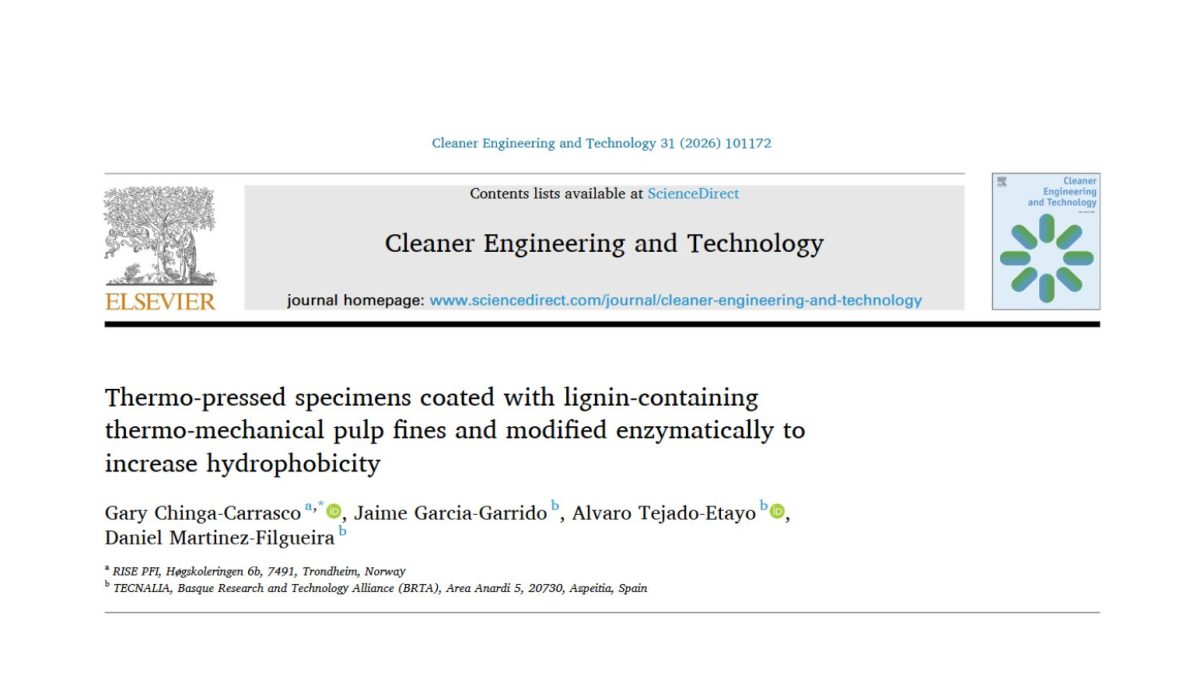
The article, entitled “Thermo-pressed specimens coated with lignin-containing thermo-mechanical pulp fines and modified enzymatically to increase hydrophobicity”, was authored by Gary Chinga-Carrasco, Jaime Garcia-Garrido, Álvaro Tejado-Etayo and Daniel Martínez-Filgueira, and has recently been published in the journal Cleaner Engineering and Technology.
The study explores how lignin-containing thermo-mechanical pulp fines can be valorised through an enzyme-based modification process to improve their water-repellent behaviour. By enhancing surface properties while maintaining the bio-based nature of the material, the research contributes to the development of more sustainable fibre-based solutions with improved performance in humid conditions.
Valorising wood-based side streams
Beyond enhancing water repellence, the study also evaluates the balance between hydrophobicity and mechanical performance, a crucial consideration when developing fibre-based materials for packaging applications. This assessment is essential to ensure that improvements in surface behaviour do not compromise structural integrity or recyclability.
In this context, the findings are closely aligned with REDYSIGN’s broader objective of developing smart fibre-based packaging through innovative resource-efficient technologies based on lignocellulose.
Strengthening the scientific foundations of REDYSIGN
Within this framework, improving moisture resistance is a crucial challenge in the transition from fossil-based packaging towards smart fibre-based alternatives for fresh meat distribution. This publication further reinforces the project’s scientific foundations by demonstrating how innovative resource-efficient technologies based on lignocellulose and lignin can support circular, recyclable-by-design packaging systems.
As highlighted by one of the authors: “This publication demonstrates how fines, a key component of mechanical pulp, can be enzymatically modified and strategically reallocated to engineer smooth surfaces that impart hydrophobicity, a critical property for food packaging applications.”
This publication was developed by Gary Chinga-Carrasco, Jaime Garcia-Garrido, Álvaro Tejado-Etayo and Daniel Martínez-Filgueira, from RISE PFI and TECNALIA, whose work within REDYSIGN contributes to advancing sustainable fibre-based packaging innovation.