

Adhesives are common items used daily for sealing, packing, repairing, or holding things together for long or short periods. If we take a broader picture, we need adhesives in packaging, construction, automotive and aerospace industries, and in electronic and medical devices. Adhesives of various types account for a significant portion of the worldwide market.
Traditional adhesives that perform well are typically made from fossil fuels. This is particularly relevant because, in packaging processes, these polymers can usually be sealed easily by simply melting the lid onto the tray. However, as concerns about the carbon footprint, microplastics, and harmful chemical influence caused by fossil-based raw materials are growing, scientists are looking for alternative solutions.
Recent efforts to replace fossil-based adhesives with bio-based alternatives have led to the development of for example lignin-based adhesives (for binding plywood and introducing flame-retardancy), soy protein adhesives, bio-based polyurethanes, starch, chitosan, and tannin-based polymers, bio-epoxy resins, and biomimetic adhesives. However, in the food packaging sector, industry and safety standards create significant challenges, an area we are actively addressing within the framework of the REDYSIGN project.
Many bio-based polymers do not pass the strict food safety regulations, as all food contact materials must be broadly tested for the migration of substances, especially if they are in contact with moisture-containing products. In addition, using food-grade materials like starch and soy protein in adhesives is not desirable as it causes competition with the food supply chain. Many bio-based adhesives offer only limited moisture-resistance, show performance limitations compared to conventional sealing methods and are not always scalable. Furthermore, food manufacturers must also imply changes at their production process when changing from conventional heat-sealing polymers into bio-based adhesive alternatives, causing increased costs, which also increases the final product price to the end consumers.
Wood-derived sugar-based adhesives
At VTT, we took the challenge in creating bio-based adhesives, that would be easy to apply to food packaging, seal and which would be potential for upscaling without necessary extra load on the food supply chains, a key contribution to the development of recyclable-by-design fibre-based packaging within the REDYSIGN project.
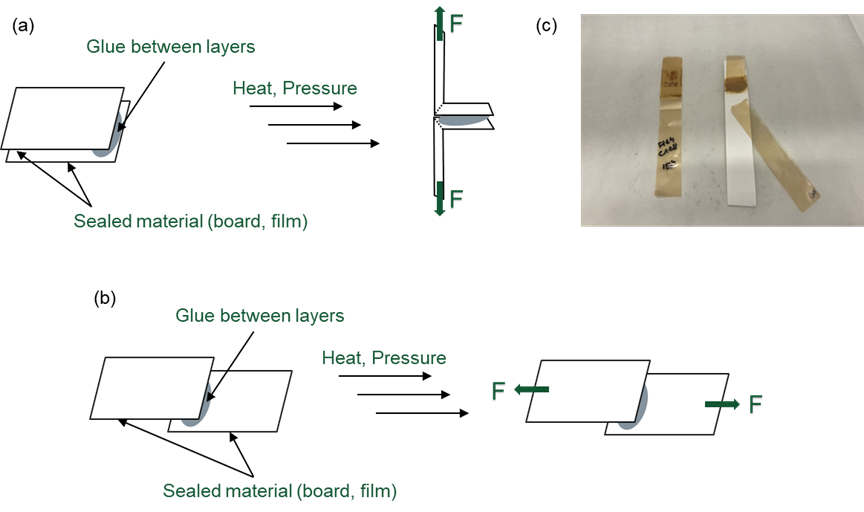
We have taken a sugar-based adhesive formulation, that previously demonstrated excellent plywood gluing properties, as the basis for the food package adhesive prototype. We prepared several formulas from wood-derived xylose and glucose (produced by our partner Fibenol), with citric acid as the crosslinking agent. Catalyst usage for crosslinking was excluded, as we did not want anything extra in contact with the food package components. We tested the adhesives in sealing cardboard, carboard-film and film specimens, and evaluated them in laboratory conditions for their seal strength and water resistance. The xylose-based adhesive demonstrated weaker performance, but the glucose-based, although requiring high temperature for sealing, was performing well even in gluing two films together.
Based on the tests, a final choice was made, and best formulations are now ready to be tested in the actual gluing prototypes where the adhesive will be used in glueing the lid to the tray.
Article prepared in collaboration with the VTT Team: Senior Research Technician Vuokko Liukkonen and Senior Scientist Tetyana Koso, who were responsible for the adhesive work.